
Walk an Orange Street by Address
An Orange street search works best when every stop has a narrow job. The Orange tax record anchors a modern parcel. The Orange map supplies the block and lot. The Essex deed index identifies recorded parties and dates for Orange land. Historical Orange street sections can then add a dated household clue. None of those records alone proves every person at an address, but their agreement can establish a careful Orange property history. Start with the exact Orange municipal address, not a nickname for a neighborhood or a ZIP alone.
- Confirm the postal form of the address with USPS ZIP Code Lookup, then retain the street spelling and municipality.
- Check the Orange 2024 proof book or contact the Tax Assessor for the listed owner, situs, mailing address, and block and lot.
- Use NJGIN to locate the parcel and tax block, then note the identifiers before browsing nearby polygons.
- Run the municipality and block/lot, then the owner or company name, through Essex PRESS to find recorded deeds and the parties named in them.
- For an earlier household lead, consult a dated Oranges criss-cross or street section and compare it with the historical page image.
That Orange order prevents a common mistake: treating the name on a tax mailing line as the person currently living at the Orange situs. It is a sound ownership and correspondence lead, not a complete Orange household record. A person-focused question may need the separate Orange resident lookup workflow after the Orange address evidence is gathered.
Orange Street Directory Address Labels
Three address labels can point to the same Orange parcel and still differ. The situs, or property location, is the physical Orange street address. The owner mailing address is where the tax office sends correspondence and can be in Orange, Belleville, Jackson, or another place. The legal description may use only the block, lot, and related land description. Record all three before comparing sources.
- Parcel
- A tax-mapped unit of land, commonly identified in Orange records by block, lot, qualification, or account information.
- Situs address
- The physical property location used by the tax roll. It can differ from the owner mailing address.
- Legal description
- The land identifier carried in a deed or related record. It is more stable than a casual street reference when tracing a property.
- Criss-cross directory
- An address-to-occupant directory arranged by street and number, useful as a dated historical lead rather than proof of ownership.
Historical Orange sources add another complication. The regional directories may label a place Orange, East Orange, South Orange, West Orange, or use abbreviations such as O, EO, SO, and WO. Preserve the printed municipality, street spelling, and number before translating it into a current Orange search.
Use Orange Proof Book Blocks
The Orange Tax Assessor’s annual proof book is the dependable local fallback while the linked Asset Registry application does not expose its live search fields in accessible page text. The inspected 2024 book shows owner name, owner mailing address, property location, block/lot/account, dimensions or acreage, class, zoning or map information, assessed values, exemptions, deductions, taxes, and ZIP-related fields. Municipal assessors file annual lists in January, so a later transfer may not yet appear.
The Orange Tax Assessor maintains Orange assessment rolls, tax maps, exemptions, and property inquiries. Use the Orange proof book and assessor contact to match an Orange street number with the tax identifiers needed by NJGIN and PRESS. The record describes Orange tax administration. It does not establish every current occupant or every relationship inside the property.
Note: Save the list year beside each proof-book result because Orange ownership fields can lag a later recorded transfer.
Search Orange Streets in NJGIN
NJGIN’s parcel page leads to statewide Property Explorer resources, parcel downloads, and Essex data. Property Explorer advertises address, county, municipality, block, and lot searching for Orange parcels. The Cadastral service supplies Parcels and Tax Blocks layers, while the statewide address layer carries parsed address and subaddress information, postal fields, road linkage, and aliases where available. The Orange address data is updated monthly, but it is not an Orange resident roll.
| NJGIN field or layer | Type | Required status | Orange street use |
|---|---|---|---|
| Address | Text or autocomplete | No stated requirement | Find a street address or place and begin a map view. |
| County | Filter | No stated requirement | Select Essex to narrow parcel context. |
| Municipality | Filter | No stated requirement | Select Orange to separate it from nearby Oranges municipalities. |
| Block and lot | Text or number | No stated requirement | Join the map to the proof book and PRESS records. |
| Parcels and Tax Blocks | Map layers | No | Inspect street segments and adjacent mapped parcels. |
| ZIP or export | Not confirmed | Research gap | Do not assume a ZIP-wide search or bulk export in the Orange application. |
The available NJGIN parcel-viewer image shows the statewide resource that supports this part of the Orange street directory.
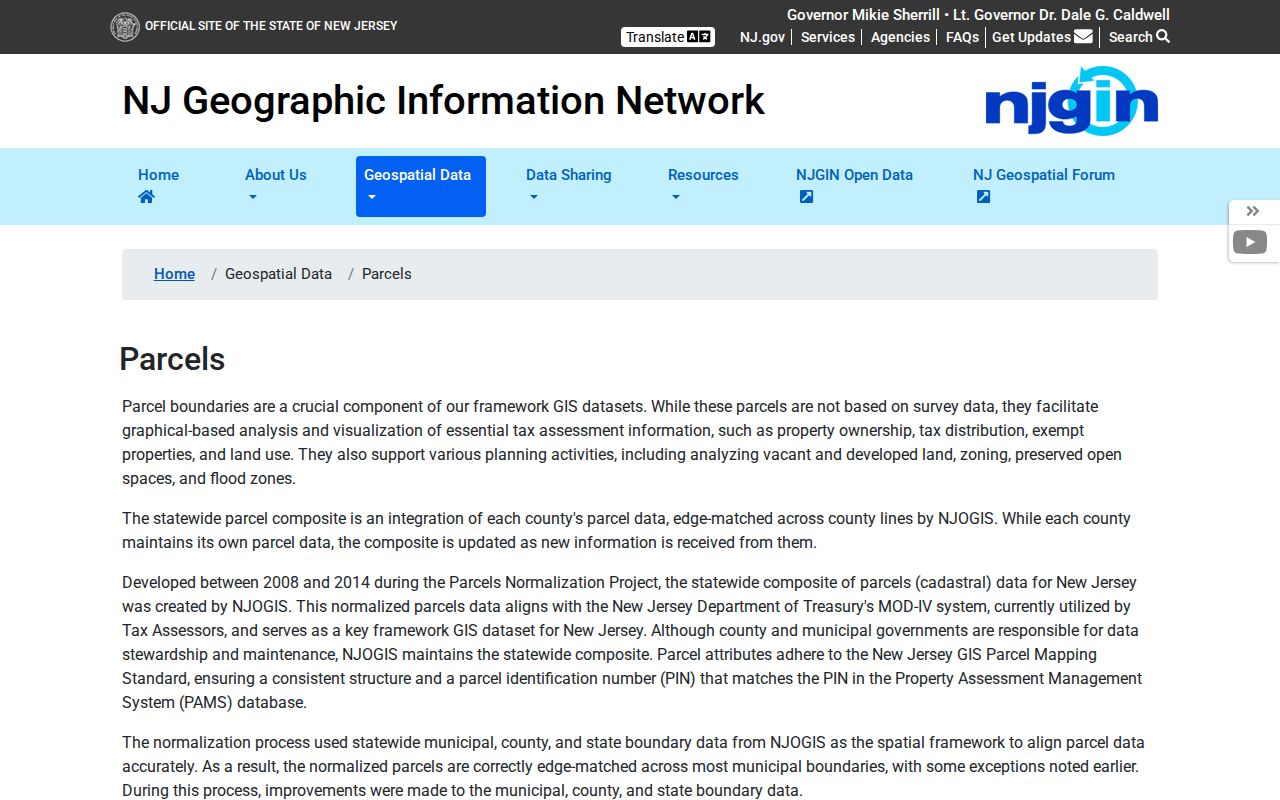
Use the viewer to discover spatial relationships, then cross-check block and lot against the Orange proof book or the Register. NJGIN warns that parcel polygons are not surveys or legal boundaries, and Daniel’s Law can redact protected owner names.
Orange Street Map Changes in 2026
NJGIN announced newer county and municipal parcel data in April 2026, then an August 2026 statewide update that included Essex geometry changes. The agency said that the geometry update did not change MOD-IV attributes. That distinction matters for a street directory result: a boundary display or map alignment can change while an annual tax attribute stays the same.
The March 2026 migration away from a mature-support parcel service and a May maintenance notice also explain why a map can behave differently at different times. If the online map is unavailable, use the Orange proof book, an assessor inquiry, an OPRA request for a defined record, or the Essex Register’s office records instead of guessing from an old screen capture.
Orange Street Directory Record Coverage
Each address-keyed source answers a different question along an Orange street. The table keeps Orange property, map, recorded-document, historical directory, and municipal-file evidence distinct. It also shows why the full Orange street directory process has more than one access channel when a web search does not return enough detail.
| Address record | Orange or Essex keeper | What it can show | Access route |
|---|---|---|---|
| Annual tax proof book | Orange Tax Assessor | Owner, mailing address, situs, class, values, and block/lot | Annual PDF, assessor office, and tax-map contacts |
| Parcel and address layers | NJGIN | Mapped parcels, tax blocks, address points, and road links | Free statewide map and data services |
| Recorded deeds and related instruments | Essex Register | Parties, document type, date, instrument data, and block/lot | PRESS index, Public Vault, or Newark office books |
| Historical street and criss-cross pages | Newark and West Orange libraries | Dated address-to-occupant and telephone leads | Reference staff, microfilm, hard copy, and selected digital pages |
| Completed permit or code file | Orange departments and Clerk | Defined address and date records if lawfully releasable | Department inquiry or address-bounded OPRA request |
An individual voter-status tool is not an Orange street-wide roster. The captured state endpoint did not expose a public block search, and no official county full-file request form, fee, or delivery specification was located. Direct questions about lawful voter-file access to the Essex Commissioner or Board of Elections rather than treating a status result as household evidence.
Follow Orange Street Deeds in PRESS
The Essex PRESS search has modes for instrument number, document type, block and lot, and name. An Orange block/lot search accepts municipality, block, lot, and a date range. A name search accepts a last or company name, optional first name, document type, and optional date range. Record the grantor and grantee roles with the instrument number and recording date, then test the seller as an earlier Orange buyer for a backward chain.
PRESS limits date queries to 90 days, even when quick controls offer 3, 7, 15, 30, and 90 days. Narrow a long street history into successive windows. The Register says remote electronic/Public Vault material begins May 1, 2001, while the active search screen separately displays 10/01/1996 onwards. Check the selected record type near that boundary, then use the Public Vault, office books, and Newark counter for older research. The Register’s staff can demonstrate indexing but will not perform a title search.
The PRESS index image documents the search interface used for Orange deed and block/lot work.
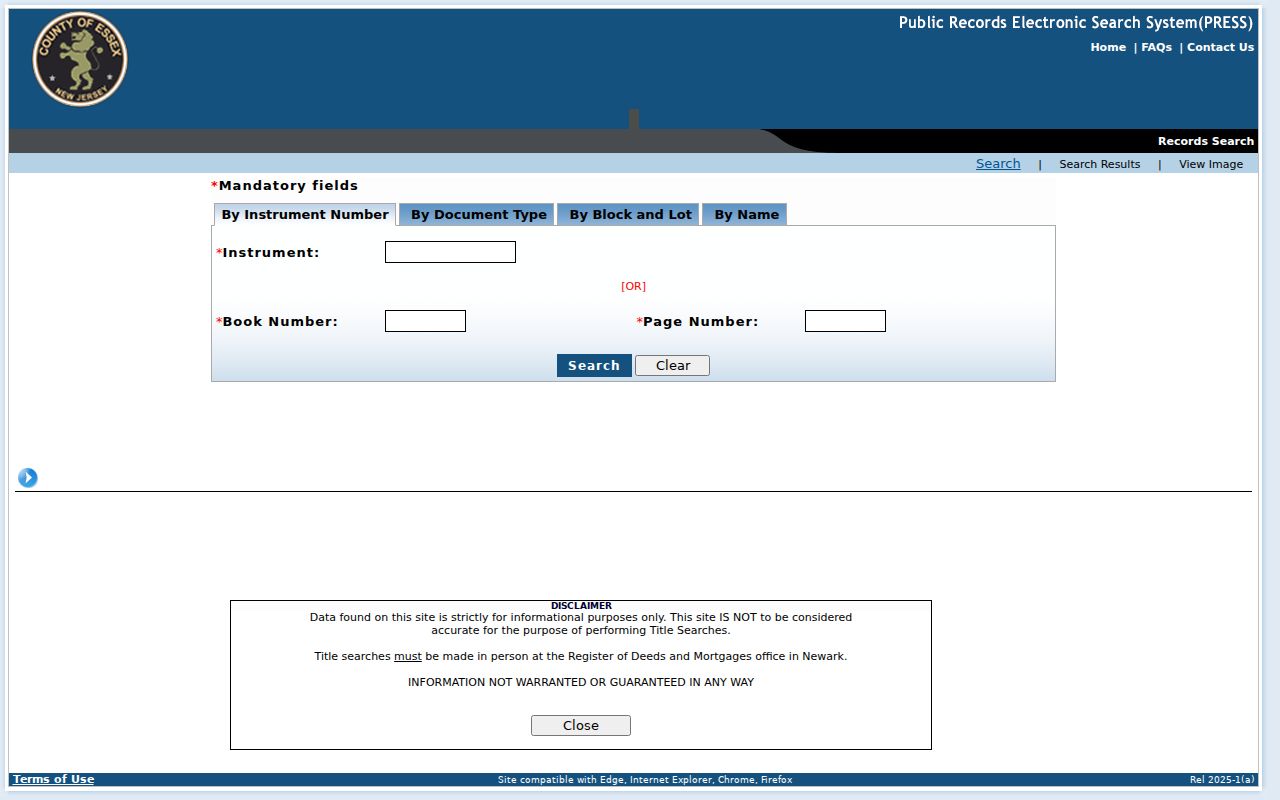
Recorded parties and dates help explain a parcel’s transaction history. They do not convert the index into certified title work, and certified or official copies remain an office service.
Orange Street Directory History Pages
Historical Oranges volumes are valuable for a street number because their criss-cross sections can show occupant, vacancy, telephone, and neighboring entries in a particular edition. Newark Public Library’s Cummings collection holds reverse directories for Newark and Suburban Essex, with separate volumes from about 1972 through 2019, alongside broader directory and phone-book holdings. West Orange Public Library reports Directory of the Oranges coverage from 1879 through 1956.
Read the page image, not only OCR. The 1916, 1928, 1936, 1959, and 1961 material uses forms such as h for house, bds for boards, r for resides with, wid for widow, and do for ditto. A combined Oranges title can include Orange, East Orange, South Orange, West Orange, Maplewood, Irvington, Livingston, or Millburn. The regional collections themselves are described in the Orange directory book.
Note: A historical street entry is a dated lead, so retain its edition, page, municipal abbreviation, and exact printed address.
Orange Street Permit Records
Orange lists construction, electrical, elevator, fire-protection, mechanical, plumbing, zoning, planning, certificate-for-sale or transfer, and tax-appeal forms. The public Orange forms page did not expose a completed permit or code-case search. An Orange permit can date work at a property, but it should not be read as proof that an applicant lived there.
When an online Orange street search stops, use the Orange OPRA request form for a defined address, record series, and date range. The form provides delivery options including pick-up, mail, fax, email when available, and on-site inspection. Ask the Clerk which department is the custodian. A broad request for every person on a street is not a defined municipal record description.
Orange Street Directory Geographies
A ZIP, ward, neighborhood, parcel, and street segment are different geographic systems. Orange uses 07050 for standard street addresses, while 07051 should be treated cautiously as PO Box or special postal use until USPS confirms a street delivery result. City wards include at-large, East, West, North, and South representation. HANDS’ Valley and Heart of Orange descriptions are community-boundary narratives, not tax or postal boundaries.
Orange covers 2.21 square miles, so a short map browse can cross civic, postal, rail, and neighborhood labels quickly. Use the municipality plus block and lot to keep a street search in Orange. Historical records complicate this further: Orange became a city in 1872 and reclassified as a township in 1982, while nearby municipalities separated over time. No verified Orange street-renumbering year was located, so compare intersections, Sanborn maps, and block/lot rather than inventing one.
Orange Street Directory Privacy Limits
The Orange street directory cannot identify every household member, utility subscriber, delivery address, DMV record, or protected address. NJGIN may redact owner names under Daniel’s Law. The New Jersey Address Confidentiality Program can provide a substitute legal address for eligible participants. OPRA also carries privacy exemptions for personal identifying data and protected records. A blank field can be an intentional legal protection, not a research error.
Lawful use. Orange street and property records are for personal, lawful research and civic or historical questions. New Jersey’s anti-stalking law, N.J.S.A. 2C:12-10, can apply to conduct used to harass, track, threaten, or intimidate another person.
Use official records for the limited question they answer, retain the source and date, and verify important results with the custodian. Do not turn address data into a surveillance file or republish protected information.