
Orange Resident Lookup Coverage
One name does not lead to one master file in Orange. The useful record depends on the question. The Orange assessment roll can identify a listed owner and the parcel's mailing and situs fields. Essex recorded documents can show a party to a dated transaction. The court system supplies case metadata, and a library directory may place a household in an earlier edition. Each result needs its custodian and date beside it. A tax mailing address is correspondence evidence, for example, not proof that every person at the property lives there.
| Record | What It Confirms | Where | Access |
|---|---|---|---|
| Tax proof book and parcel record | Listed owner, mailing address, situs, block and lot | Orange Tax Assessor and NJGIN | Annual proof book and map layers; protected parcel names can be redacted |
| Recorded-document index | Grantor or grantee role, instrument, date, and block or lot | Essex PRESS | Free index; images, certified copies, and title research follow Register rules |
| Court inquiry | Party, docket, case type, venue, status, and dated proceedings | NJ Courts Find a Case | Free metadata inquiry; file access and confidential matters have separate limits |
| Vital record | Eligible event and relationship facts | Orange Vital Statistics, NJDOH, or Archives | Restricted modern records; historical genealogy routes vary by custody period |
| Historical directory | Edition-specific household, address, phone, or business context | Newark Public Library | Reference, microfilm, and collection access; not current-residence proof |
Start with the record that directly fits the fact being checked. A parcel question belongs with the assessor and deed index. A dated legal matter belongs with the Judiciary. A family-history event belongs with the appropriate vital-record custodian. Keep negative findings too, such as a wrong municipality, incompatible date, different middle initial, or a party role that does not fit the person being checked.
Matching an Orange Resident
Common names create the largest risk of a false Orange match. Preserve middle initials, suffixes, spouse or parent names, age or year, a former street, entity role, municipality, and the record date. The Orange proof book separates a property location from an owner's mailing address. That distinction can expose a mismatch instead of confirming one. A directory entry may show a household at an address in one year, while a court party entry supplies legal context in another year. Neither record should be stretched beyond what it says.
Use independent records to check the same person. A strong chain can pair a parcel block and lot with a deed instrument, then compare a court party's date or address where it appears. For older work, pair a directory entry with a census or newspaper source. The historical collections behind an Orange name trail are described in the Orange Directory Book. Note: A match remains a lead until the name, place, date, and role agree across the records.
Orange Resident Lookup Through NJ Courts
NJ Courts Find a Case is the statewide starting point for civil, criminal, judgment, tax, and municipal routes. The public Case Jacket guidance describes an Individual or Business choice, required last and first names, an optional middle initial, and a CAPTCHA for party searching. When both name terms are two characters or fewer, the party search is exact only. When either term has three or more characters, it broadens the query. That rule makes initials and spelling variants worth testing, especially for a short surname.
The screenshot of the NJ Courts Find a Case landing page shows the separate court paths that feed a resident lookup.
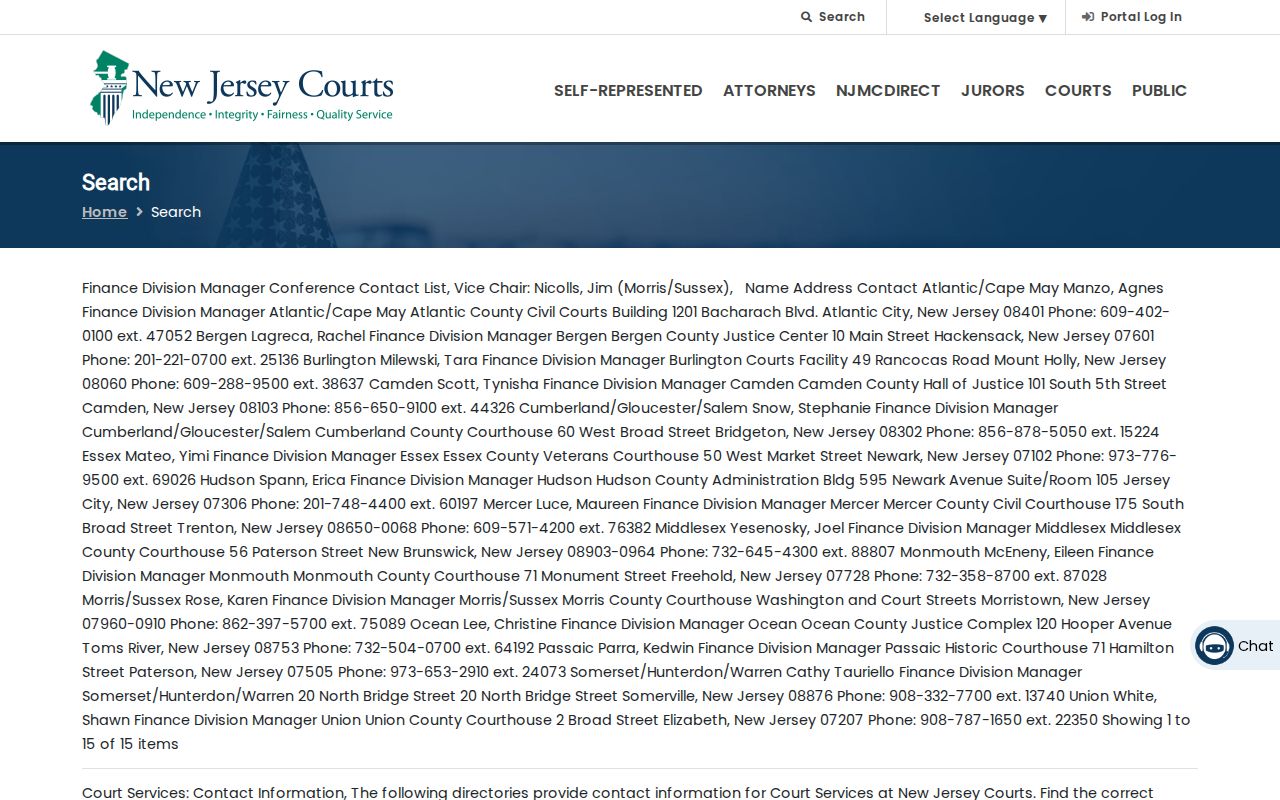
Choose the matching division rather than treating every result as the same kind of case. Orange Municipal Court is a local contact point at 29 Park Street, Orange, NJ 07050, 973-952-6315. Superior Court and other statewide matters follow their assigned division and Judiciary records procedure.
Reading an Orange Court Result
A court hit is inquiry metadata, not a finding about a person's present address or character. The public result can provide enough fields to decide whether a request is worthwhile, but it does not generally supply the text or image of every filed document. Read the disposition and the party role before drawing any conclusion. Juvenile, sealed, expunged, adoption, family, and protected-victim material may not be available through ordinary inquiry.
| Result field | What it can show |
|---|---|
| Party and caption | The named people or entities and their litigation roles |
| Docket number and venue | The case identifier and court or division handling it |
| Case type and dates | When a matter began and its broad category |
| Attorneys, proceedings, and disposition | Public status context where the inquiry makes it available |
| Filed-document list | A list of papers or orders, without a promise of document text or images |
For a file or certified court copy, use Judiciary Form 10200 or JEDS where the court permits it. The form supports inspection and several delivery or certification choices. It is more precise to request a known docket than to ask a court office to conduct a broad person search.
Verify an Orange Resident Across Records
Anchor a name to a place before adding more records. Start with the annual Orange tax evidence or a NJGIN parcel, then compare a recorded deed and, when relevant, a court party result. This sequence keeps ownership, mailing, legal event, and historic household facts in their own lanes. It also produces a useful record log with the search spelling and date.
- Record the full name, variants, known Orange address, municipality, and date range. If an address is known, retain the parcel block and lot rather than only the street number.
- Check the proof book or NJGIN for the listed owner, mailing address, situs, and parcel identifier. Flag any difference between the mailing address and the Orange property location.
- Search Essex PRESS by name or block and lot, then compare the document date, municipality, and grantor or grantee role. Narrow long date work into repeated windows because PRESS caps a date range at 90 days.
- Use the court party search for dated context. Compare the docket, party role, venue, and case date with the other records, then request a lawful copy only when the identifiers agree.
- Docket
- A court's identifying number for a case. It helps the clerk or records center locate the right matter.
- Index
- A searchable list of record metadata, such as a party name, instrument number, or date. It is not the full record itself.
- Filed-document image
- A scan or text of an actual paper. Free inquiry may list the filing without providing its image or text.
- Certified copy
- A custodian-issued copy carrying the court or office certification requested for a specific official purpose.
Orange Vital Records for Resident Lookup
Vital records are not an open name database. Orange Vital Statistics handles events that occurred in Orange, subject to the requester, identification, relationship, and copy rules. The local page lists $20 per document and an approximate one-week turnaround when the completed form, identification, payment, and self-addressed stamped envelope are supplied. If the event occurred elsewhere, Orange is not the right local custodian.
The NJDOH ordering information distinguishes certified, certification, and genealogy paths.
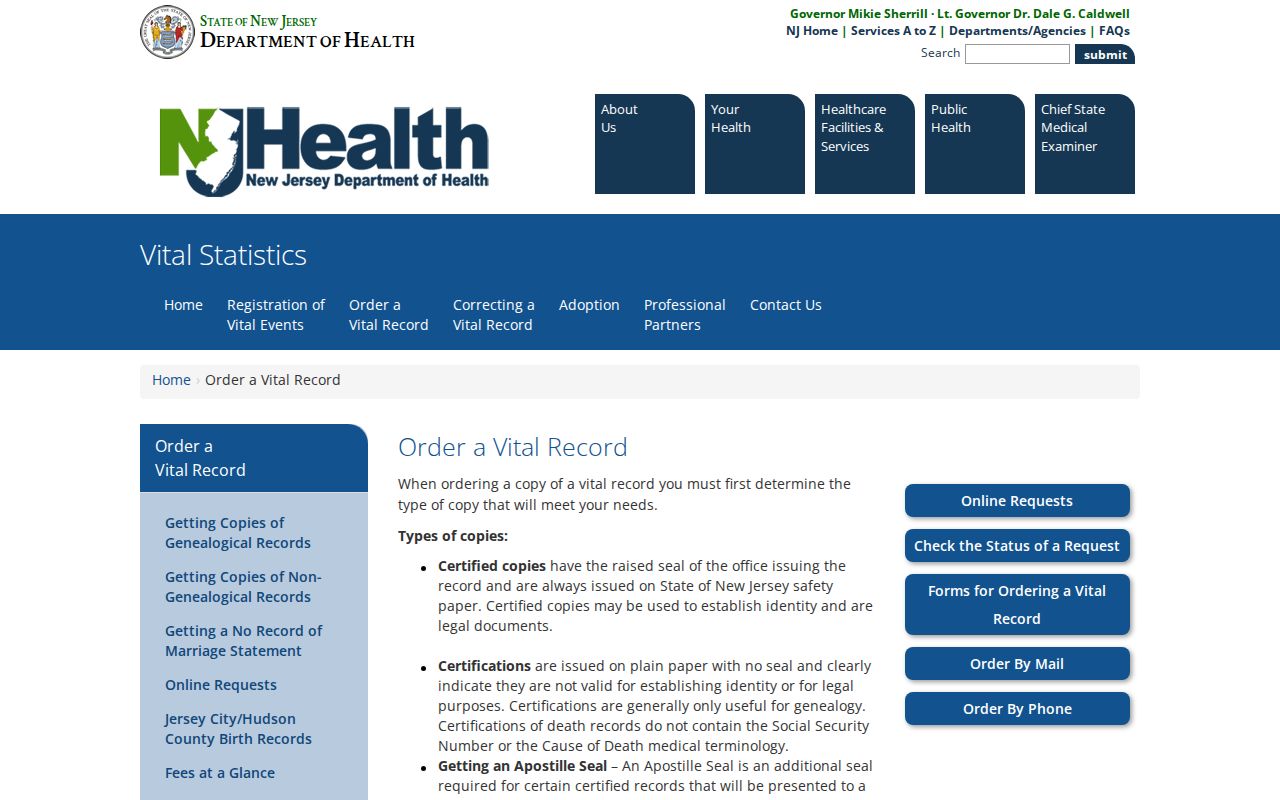
NJDOH holds state-maintained births beginning in 1925 and marriages and deaths beginning in 1951. The State Archives holds births through 1924 and marriages and deaths through 1950. Those cutoffs identify custody, not an automatic right to a record. Eligibility and the selected form still control access.
Orange Voter Status Is Not a Directory
The official New Jersey voter status portal is for an individual registration check. Its live form returned a 403 during the research capture, so exact field labels should not be guessed. Even when an individual result is available, it is not a household roster, a street list, or evidence of who occupies a parcel. A full voter file is a separate county or state request channel with its own current rules, fields, redactions, format, and fee questions.
For a documented access question, contact the Essex Commissioner of Registration at Room 103, 495 Martin Luther King Jr. Boulevard, Newark, 973-621-5061, or the Board of Elections at Room 145, 973-621-5070. Ask for the current request procedure instead of assuming the status portal supplies the same data. Note: Voter status can change through list maintenance, so save the returned status and date.
Orange Resident Lookup for Heirs
An heir question needs an estate route, not a generic name search. No verified Essex probate name portal was found in the reviewed official sources. Start with the decedent's name, date, and county, then ask the Essex Vicinage or Surrogate which probate or Chancery record series applies and whether an OPRA request, counter request, or JEDS or Judiciary records request is appropriate. A public docket item, obituary, and later deed can be useful dated clues, but none alone establishes a present address or legal relationship.
New Jersey also has a separate confidential path for adult adoptees and birth parents. The official REG-36 birth-parent and adoptee request handles contact-preference and family-history information through the Adoptees Birthright Act process. It is not a public resident search. For classmates or earlier households, use directory and yearbook collections with the right school, year, municipality, and edition rather than turning an old entry into a current claim.
Orange Resident Lookup Privacy Rules
Some absent information is legally protected, not a failed search. The New Jersey Address Confidentiality Program can provide a substitute address for eligible safety participants. Daniel's Law has a distinct protection for covered judicial officers, prosecutors, law-enforcement officers, and immediate household family members. The Office of Information Privacy administers the Daniel's Law process, and NJGIN redacts protected owner names from its hosted parcel tools.
OPRA, N.J.S.A. 47:1A-1 et seq., begins with access but also requires privacy safeguards. Orange's local OPRA form is the practical fallback for a defined municipal record, address, and date range. It provides delivery and cost fields, while a verbal request is not an OPRA request. Do not use a missing parcel, court, voter, or address field as permission to infer the hidden information.
Lawful Limits on an Orange Resident Lookup
Use records for a specific, lawful question, such as confirming a family-history fact, checking a deed party, or resolving an address discrepancy. Verify the result with the custodian before relying on it. New Jersey's anti-stalking law, N.J.S.A. 2C:12-10, can apply to repeated monitoring or conduct meant to cause fear or substantial emotional distress. Personal details from vital, motor-vehicle, protected-address, sealed, and similar records have separate limits.
Lawful use. An Orange resident lookup is for personal, lawful research. Do not use records to stalk, harass, intimidate, or harm anyone, and do not republish protected address information.