
Orange City Directory Holdings
Orange does not have one uninterrupted municipal directory series. The strongest evidence is spread among a State Library bibliography, regional library collections, microfilm, and selected digitized pages. That spread matters. A gap between two listed editions is a gap in the verified run, not proof that no directory was published. Begin with the year closest to the question, then compare the next documented edition. The State Library list identifies the early Society Blue Books, the 1916 Price & Lee volume, several mid-century combined volumes, and later Price & Lee editions.
| Collection | Years | Where Held | Access |
|---|---|---|---|
| Society Blue Book for the Oranges, Dau Publishing Co. | 1906, 1908 | NJ State Library bibliography; Montclair Public Library Reel 25 noted | Historical name and address research |
| Directory of the Oranges, Irvington, Livingston and Millburn, Price & Lee | 1916 | NJ State Library; Montclair Reel 25; DigiFind-It/Maplewood pages | Page images and library copies |
| Combined Oranges directories | 1934, 1936, 1938, 1940, 1942, 1948, 1950, 1952 | NJ State Library bibliography; Montclair Reel 25 or book | Compare available editions year to year |
| Price & Lee's Oranges City Directory | 1963, 1965, 1970 | NJ State Library bibliography | Verify the edition's listed municipal scope |
| Directory of the Oranges local-interest holdings | 1879-1956 stated coverage | West Orange Public Library | Online and hard-copy local-history access |
The New Jersey State Library bibliography is the best starting index for those dated runs. For editions outside its list, the West Orange Public Library reports Directory of the Oranges coverage from 1879 through 1956 in online and hard-copy local-interest materials. Its statement is a practical access lead, not a promise that every page or every year is complete.
Orange Directory Geography
"The Oranges" is a records quirk with real consequences. A title that sounds like an Orange-only volume can also carry East Orange, South Orange, West Orange, Maplewood, Irvington, Livingston, or Millburn entries. The 1916, 1928, and 1936 examples make the point clearly. A reader should not assign a person to Orange from the cover alone. Confirm the printed street, house number, and municipal abbreviation before adding the entry to a family file.
Common marks include O for Orange, EO for East Orange, SO for South Orange, WO for West Orange, and M for Maplewood. The same regional grouping reflects Orange's municipal history and later splits into neighboring jurisdictions. It also explains why a historical address may need a municipality check before it can be connected to a modern parcel or current street record.
Orange Directory Timeline
The verified sequence begins with the Society Blue Books and then moves through Price & Lee and combined Oranges editions. It is useful as a checking timeline, not as a claim of annual publication. The absence of a listed year should prompt a library query rather than an invented gap explanation. The local directory story is regional: a family can remain in the same general area while its municipality label changes within the books.
| 1906 and 1908 | Society Blue Book for the Oranges, published by Dau Publishing Co., appears in the State Library bibliography. |
|---|---|
| 1916 | Price & Lee's Directory of the Oranges, Irvington, Livingston and Millburn is documented. |
| 1934-1952 | Listed combined editions include 1934, 1936, 1938, 1940, 1942, 1948, 1950, and 1952. |
| 1963, 1965, 1970 | Price & Lee's Oranges City Directory editions are documented in the bibliography. |
West Orange's library description pushes the local-interest shelf further back to 1879 and through 1956. Digitized samples from 1916, 1928, 1936, 1959, and 1961 are also located in the DigiFind-It/Maplewood viewer. The differing date spans are complementary, not interchangeable. Cite the edition, page, and repository so another researcher can locate the same evidence.
Note: Use a listed edition as evidence of that edition only, because the research did not verify a complete annual publishing run.
Newark Directory Collection Access
The Cummings NJ Information Center at Newark Public Library is the region's broad fallback for city directories, reverse directories, and phone books. Its collection description covers hard-copy and microfilm city directories roughly from 1835 into the 1980s, New Jersey Bell directories roughly from 1900 to 1990 depending on locality, statewide directories, and born-digital phonebooks from 2019 onward. For Orange research, ask for the Orange or Oranges edition and, when relevant, the street section rather than a generic name search.
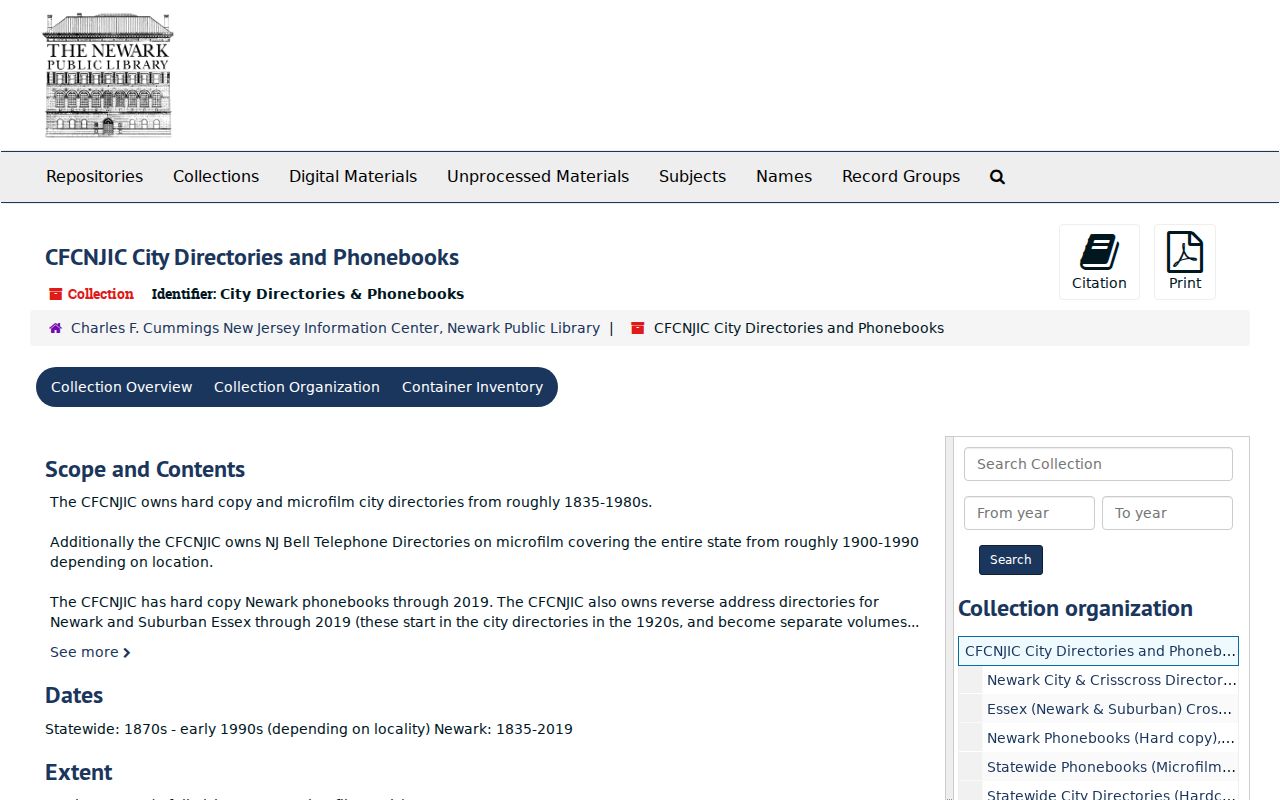
The collection record identifies the Cummings holdings used for city-directory, reverse-directory, and phonebook research.
The collection is on the third floor at 5 Washington Street, Newark. Reference staff can be reached at 973-733-7775 or njreference@npl.org. Reverse or criss-cross volumes are especially useful after an address is known, but an entry still needs its edition and page retained because occupants, phones, and addresses change.
Reading an Orange Directory
A city directory entry can be dense. The digitized 1916 material shows personal names, honorifics, occupations or businesses, household and boarding relationships, and street addresses. A person may appear under a spouse's name, an initial, a business, or an abbreviated address. OCR can also flatten punctuation and old type. Read the image, copy the wording as printed, and only then add a modernized search term in notes.
| Name and initials | Identify the person as printed, including title, middle initial, or widow form. |
|---|---|
| Occupation or business | Can distinguish same-name entries and provide a dated local connection. |
| Household marker | Look for spouse, boarder, residence-with, or widow notation rather than assuming a relationship. |
| Street address | Transcribe number, street spelling, and locality mark exactly before testing a modern form. |
| Entry abbreviations | Use the volume's key for terms such as h, bds, r, do, and wid. |
- Criss-cross directory
- A directory arranged by street and number, used to find an historical occupant or telephone lead from an address.
- Householder index
- An alphabetical arrangement that points from a name to an address or household entry; its scope varies by edition.
- Abbreviation key
- The volume's explanation of short forms. In Orange material, it is essential for terms such as h for house and bds for boards.
The 1928 key also uses forms such as ab, adv, agt, av, clk, and emp. These words can change the meaning of a search. A surname with a street address is stronger when the occupation, initials, and municipality mark also fit.
Orange Criss-Cross Directories
Newark and Suburban Essex criss-cross directories began in the 1920s, with separate volumes roughly from 1972 through 2019 in the Cummings collection. Their address-to-occupant arrangement is a different tool from an alphabetical directory. The 1959 and 1961 materials show how a street row can record a house number, occupant, vacancy, telephone, and neighboring entries. That makes the criss-cross a useful historical lead for a specific address.
It does not establish ownership. A tax roll and a recorded deed answer different questions, while a directory can include boarders or several households. For current property-oriented work after an old address is normalized, use the Orange Street Directory process rather than treating a historical street listing as a current result.
Telephone directories at Cummings offer a second check, but their locality coverage depends on the volume. A missing name can mean an unlisted number, a different household form, an edition gap, or an address outside the book's stated scope.
Orange Historical Society Context
Directory work becomes more reliable when a name or address is checked against an independent local source. The New Jersey Historical Society's Orange geographical holdings identify Orange family, church, physician, historian, and business-related materials, including the Condit family papers, First Presbyterian Church, Grace Church, Joseph Warren Greene Jr., William Pierson, and Ambrose Tomkins. These are collection leads, not a complete index of every Orange resident.
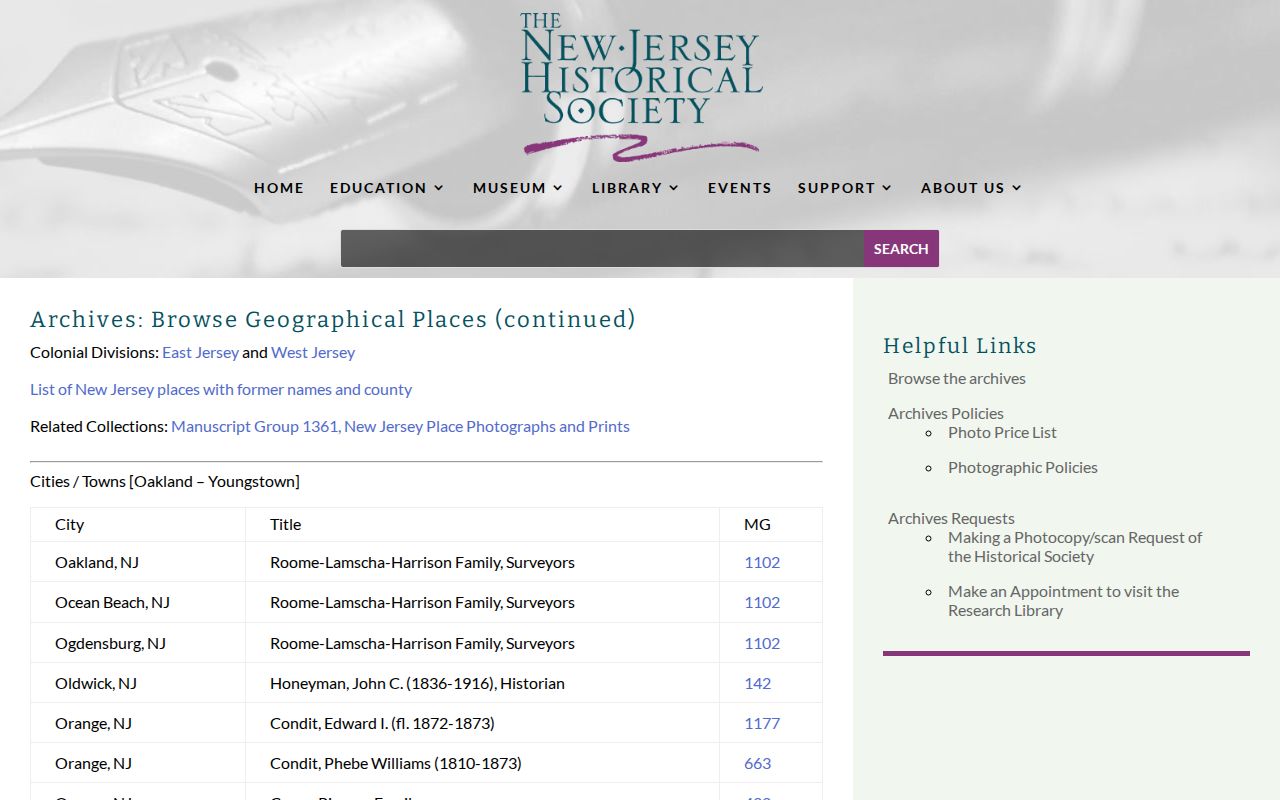
The Historical Society holdings page is a starting point for Orange family, church, and community context that can help interpret a directory name.
The same repository lists Orange Journal microfilm from 1854 into the 1890s with gaps and Orange Chronicle microfilm from 1904 to 1908. Newspaper notices can test a business address, death notice, church association, or local event, but they do not turn a directory entry into proof of a current address.
Note: Keep the original citation beside any directory transcription, because a manuscript or newspaper item may clarify an identity without confirming present residence.
Tracing an Orange Directory Household
Following a household works best as a dated sequence. Start with the closest confirmed entry, keep every variant exactly as printed, then move to the next available volume. The aim is not to force continuity. It is to document each appearance, move, business change, and absence. Pairing directory years with decennial census records can bridge long intervals, although the 72-year release rule means 1950 is the latest public federal census in 2026.
- Find the earliest verified name or address entry and record the edition, page, locality mark, street spelling, initials, and occupation.
- Check the next documented Oranges volume, using spouse, widow, business, and abbreviation variants before deciding the person disappeared.
- When an address is known, consult the criss-cross or street section for occupants, vacancy marks, and nearby entries in that same edition.
- Compare the dated trail with the closest released census, newspaper notice, church collection, or family paper that names the same locality.
- Use a later tax, deed, or court source only to answer its own question. Do not merge historical occupancy, ownership, and household relationship into one claim.
A missing listing has several possible explanations: the family moved, the name changed, the person died, the household used another adult's name, or the edition did not cover that type of listing. Modern identity questions need a separate confirmation path, such as the Orange Resident Lookup workflow, before a historical name is connected to a living person.
Orange Directory Map Check
The Library of Congress 1912 Orange and West Orange Sanborn set contains 130 sheets. It supplies a physical check for a directory address: the sheet can show a building footprint, construction material, use, and historical street name. It cannot name every occupant, so it belongs beside the directory page rather than in place of one.
This pairing is especially helpful for Orange's industrial past. A directory can identify a hatter, mason, shop, or business address, while a Sanborn sheet can show whether the location was a dwelling, factory, stable, store, church, or another type of structure. Save the sheet number and directory page together. That modest record trail lets a later reader separate a place fact from a person fact.